
Top 9 States With No Income Tax in 2026 (Official List)
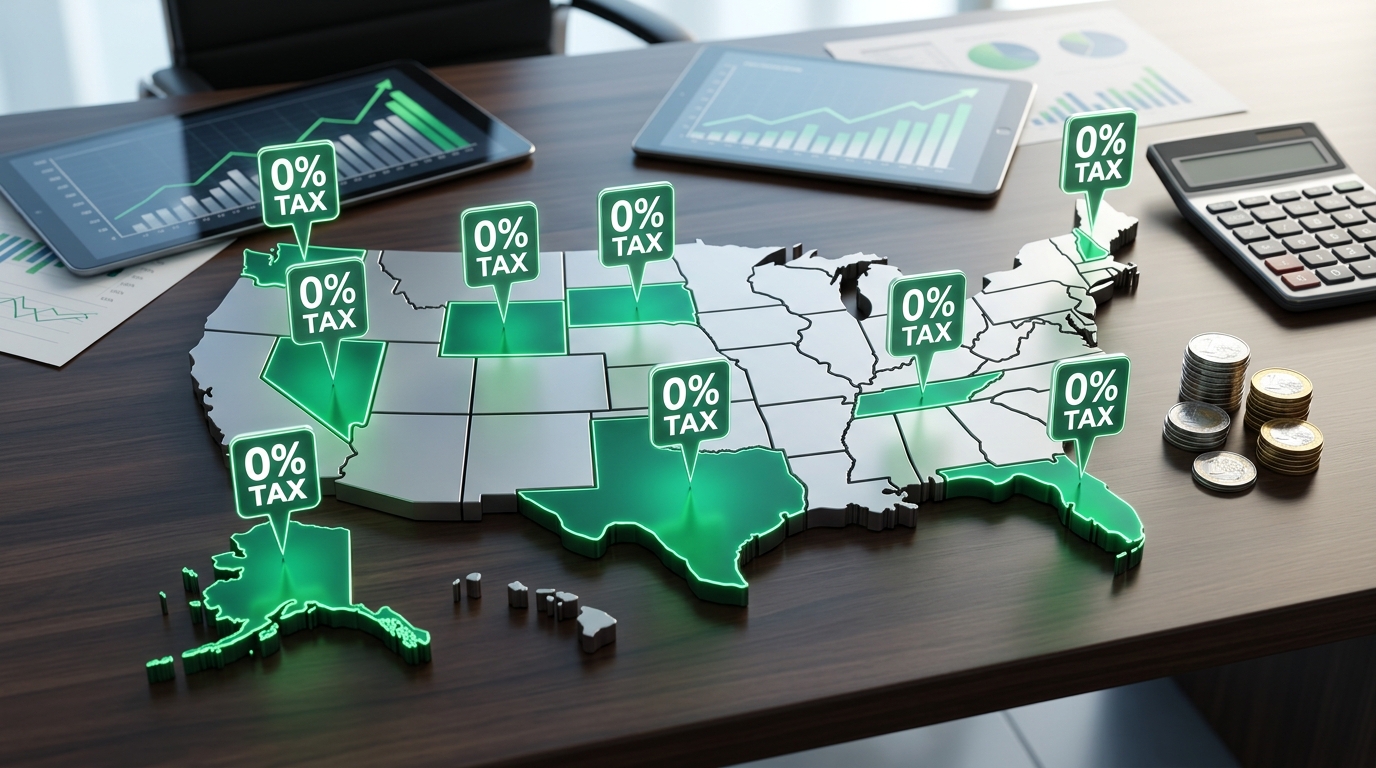
Are you searching for the complete and official list of states with no income tax 2026? You are not alone. In an era where inflation and high living costs are putting unprecedented pressure on household budgets, relocating to a tax-free haven is one of the most effective strategies to instantly boost your take-home pay.
But before you pack your bags and call a moving company, it is absolutely crucial to look beyond just the shiny “0%” income tax rate. States still need billions of dollars to fund public schools, highways, infrastructure, and emergency services. If they aren’t taking a cut from your paycheck, they are making up the difference elsewhere—often through significantly higher property taxes, aggressive sales taxes, or unique state-level excise fees.
⚡ Official 2026 Answer
According to official data, the 9 US states with no income tax 2026 are:
In 2026, the great migration of remote workers, tech professionals, and retirees toward the Sunbelt continues to reshape the US economy. To ensure your relocation is truly a profitable upgrade rather than a financial mistake, you must evaluate the “total tax burden” of each destination.
A Deep Dive: The 9 States With No Income Tax 2026
Let’s take a detailed look at the financial landscape of each of these nine states, so you can understand exactly how they compensate for the lack of state income tax.
1. Texas: The Property Tax Trade-Off
Texas has become a massive hub for corporate relocations and remote workers. The state constitution explicitly forbids a personal income tax, making it highly attractive for high earners. However, the catch in the Lone Star State is property taxes. Texas relies heavily on local property taxes to fund school districts and county services. The average effective property tax rate is around 1.80%, which is among the highest in the country. If you buy an expensive home in Dallas or Austin, your property tax bill could easily wipe out your income tax savings. To understand the real impact on your paycheck, see exactly how much you keep in Texas on a $75,000 salary.
2. Florida: The Sunshine State Premium
Florida is historically famous as a retirement haven, but post-2020, it has seen a massive influx of young professionals. Like Texas, it constitutionally protects its residents from state income tax. Instead, Florida heavily taxes tourists through hotel taxes, rental car taxes, and an average combined sales tax of around 7.00%. The biggest hidden cost in Florida for 2026 is property insurance. Due to severe weather and hurricane risks, homeowners insurance premiums have skyrocketed, often costing between $2,300 and $4,000 annually. Still, if you want to know your net pay, you can calculate your exact Florida take-home pay here.
3. Nevada: The Entertainment Subsidizer
Nevada’s zero-income-tax policy is largely funded by the state’s massive gaming and tourism industry. Casinos, hotels, and entertainment venues pay hefty taxes so that residents don’t have to. Nevada also boasts a relatively low property tax rate (around 0.55%). However, the state makes up for some revenue through high sales taxes, which can exceed 8.25% in places like Las Vegas. If you are comparing moves, checking a California vs Texas salary comparison or looking at Nevada’s equivalent can help clarify your net worth trajectory.
4. Wyoming: The Lowest Overall Tax Burden
Wyoming is often considered the hidden gem of tax-friendly states. According to multiple think tanks, Wyoming frequently ranks #1 for having the lowest total tax burden in the United States. Not only does it lack a state income tax, but it also has an incredibly low average property tax rate (0.55%) and a modest state sales tax (4.00%). The state funds itself largely through taxes on natural resource extraction, primarily coal and oil.
5. Tennessee: The End of the Hall Tax
For many years, Tennessee taxed dividend and interest income under the “Hall Tax,” even though it didn’t tax standard W-2 wages. However, as of January 1, 2021, the Hall Tax was completely phased out, making Tennessee a true no-income-tax state. The trade-off here is sales tax. Tennessee has the highest average combined state and local sales tax in the nation, often nearing 9.55%. Residents pay heavily at the cash register, but keep 100% of their earned paycheck.
6. South Dakota: Business and Wealth Friendly
South Dakota offers 0% individual income tax, 0% corporate income tax, and no estate or inheritance taxes. This makes it incredibly attractive for business owners and wealthy retirees looking to protect their assets for the next generation. The property taxes are slightly above the national average (around 1.08%), but the overall cost of living remains significantly lower than coastal states.
7. Alaska: Where the State Pays You
Alaska is unique. Not only is it one of the states with no income tax 2026, but it actually pays its residents to live there. Through the Permanent Fund Dividend (PFD), the state distributes a portion of its oil revenue to eligible citizens each year (often ranging from $1,000 to $3,200 per person). Furthermore, Alaska has no state-level sales tax, though some local municipalities do charge a small percentage. The catch? The cost of living is extraordinarily high due to the state’s remote location and the need to import most goods.
Crucial Exceptions: New Hampshire and Washington
While often listed as “tax-free,” two states have very important asterisks that you must consider for the 2026 tax year:
- New Hampshire (The 2027 Phase-Out): New Hampshire does not tax your W-2 wage income. However, for the 2026 tax year, they still levy a 3% tax on interest and dividends. This means if you live off investments, you are still being taxed. Fortunately, this specific tax is currently phasing out and will be completely eliminated by January 1, 2027.
- Washington (Capital Gains Exception): Washington State does not tax traditional W-2 wages. However, they recently introduced a controversial 7% capital gains tax on the sale or exchange of long-term capital assets exceeding $267,000 (adjusted for inflation). If you are a tech employee selling restricted stock units (RSUs) or an entrepreneur selling a business, Washington is not entirely tax-free for you.
Total Tax Burden in States with No Income Tax 2026
To truly understand how these states operate, you have to look at the “Three-Legged Stool” of state revenue: Income Tax, Property Tax, and Sales Tax. If one leg is missing (Income Tax), the other two legs must be longer to support the state budget.
| State | Income Tax | Avg. Property Tax | Avg. Sales Tax |
|---|---|---|---|
| Wyoming | 0% | 0.55% | 4.00% |
| Nevada | 0% | 0.55% | 6.85% |
| Tennessee | 0% | 0.64% | 9.55% |
| Florida | 0% | 0.80% | 7.00% |
| Texas | 0% | 1.80% | 8.20% |
Don’t guess your relocation budget!
Use our free 2026 tax calculators to compare your exact take-home pay and living costs before you decide to move.
Calculate True Net Pay NowFrequently Asked Questions (FAQs)
1. What are the states with no income tax 2026?
The 9 states are Texas, Florida, Nevada, Wyoming, Washington, Tennessee, South Dakota, Alaska, and New Hampshire. Note that Washington and New Hampshire have specific exceptions for capital gains and investment dividends.
2. Is it cheaper to live in Texas or Florida for taxes?
While both are states with no income tax 2026, Florida generally has a lower overall tax burden for homeowners because its average property tax (0.80%) is less than half of Texas’s average property tax (1.80%). However, Florida residents face significantly higher homeowners insurance premiums.
3. Do federal taxes still apply in these states?
Yes. Moving to a state with no income tax only eliminates your state-level liability. You are still legally required to pay Federal Income Tax to the IRS, as well as FICA taxes (Social Security and Medicare) which are automatically deducted from your paycheck regardless of where you live in the United States.
The Verdict for 2026 Relocations
Moving to one of the 9 states with no income tax is a fantastic way to protect your paycheck and build long-term wealth, but it requires strategic, holistic planning. You must calculate the hidden costs of property taxes if you plan to buy a large home in Texas, understand the 2027 phase-out laws if you are retiring to New Hampshire, and budget for higher sales taxes if you are shopping in Tennessee.
Before you sign a lease or buy a new home, we highly recommend running your exact numbers through a dynamic salary calculator to ensure your relocation is truly a profitable upgrade.
Financial Disclaimer: While we strive to use official 2026 tax data from authoritative sources like the Internal Revenue Service (IRS) and state comptroller offices, the information provided by USCalcHub is for educational and informational purposes only. Actual tax liabilities may vary due to individual circumstances. USCalcHub assumes no financial or legal liability for decisions made based on this article. Please consult a qualified CPA.